
- Trading
- Markets
- Platforms & ToolsPlatforms
- Learn
- About
Compare manual, semi-automated and fully automated trading to find the right balance of control, speed and technology before choosing how you trade.
Established 2006
9M Users
Multiple Markets

Technology has shifted modern financial markets away from manual execution toward semi-automated and fully automated trading systems.
Manual trading offers high flexibility and total control but requires a significant time commitment and risks emotional errors.
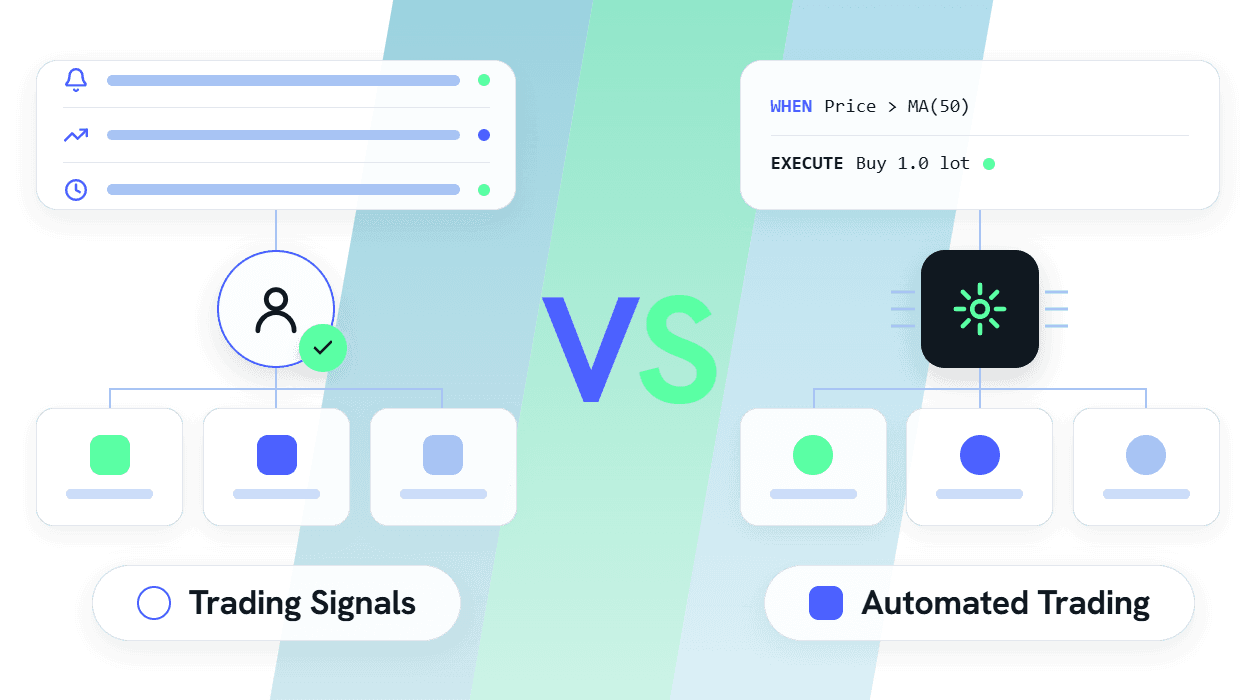
Semi-automated trading uses algorithms to identify market setups, while leaving the final trade execution decision to the human.
Fully automated trading operates around the clock at maximum speed but risks technical failures and a lack of real-world context.
Choosing a strategy depends on matching your personal skills in market analysis, coding, emotional control, and risk assessment.
The world of financial markets moves faster today than ever before. For generations, traditional trading relied entirely on human intuition, manual chart analysis, and rapid execution.
Today, technology has transformed this landscape, shifting the balance from emotional execution towards the precision of algorithmic dominance.
This evolution brings a fundamental dilemma that every modern trader must face. Should you maintain absolute personal control over every position, or do you trust automated code to execute strategies for you?
Finding the right balance between human insight and technological speed is key to navigating these dynamic markets.
At AvaTrade, we believe that understanding these tools is the first step towards cultivating true trading confidence.
Whether you prefer to analyse the charts yourself or leverage automated trading solutions, we provide the innovative environment required to empower your journey.
Manual trading is the traditional foundation of the financial markets. It relies entirely on pure human intuition, direct chart reading, and manual trade execution.
As a manual trader, you are responsible for analysing market data and deciding exactly when to enter or exit a position.
This classic method offers unique benefits, particularly when navigating unpredictable market conditions:
Despite these advantages, manual trading presents significant challenges that can hinder your long-term consistency:
Open a free AvaTrade demo account today to practise your manual trading strategies risk-free.
For many traders, the choice is not an all-or-nothing decision between human intuition and machine precision.
Instead, the ideal solution lies in semi-automated trading, a powerful hybrid method that combines the strengths of both approaches.
In this model, advanced algorithms handle the heavy lifting by scanning the markets to find high-probability setups.
However, the system does not execute the position automatically; instead, it alerts you to the opportunity, leaving the final trading decision firmly in your hands.
This setup provides a perfect blend of technological speed and human insight. You leverage the analytical power of modern trading systems to parse data across multiple assets simultaneously, without sacrificing your unique understanding of real-world market context.
Beyond operational efficiency, this hybrid method offers a profound psychological benefit. It acts as an objective safety net that helps enforce strict trading discipline, effectively protecting you from emotional mistakes like revenge trading without stripping away your ultimate control.
Semi-automated trading is not a single, rigid method. It spans a spectrum from basic scanning tools to highly sophisticated interactive systems. Understanding these different levels helps you find the right balance for your experience and goals.
Receiving an alert from your semi-automated trading platform is an exciting moment, but it should not trigger an immediate, emotional reaction. To maintain long-term discipline, you should always verify the setup before executing the trade.
This brief human intervention is exactly what protects your capital from market anomalies that software might miss. Running through a quick, structured checklist ensures you only risk capital on high-probability setups.
Before you click the execution button on your platform, ask yourself these three critical questions:
Register a real AvaTrade account now to explore our social and signals trading solutions.
At the opposite end of the spectrum lies fully automated trading. This approach offers a completely hands-off execution model, where sophisticated software handles every aspect of the trading process based on preset parameters.
To navigate this space effectively, it helps to distinguish between a few common terms. Rigid algorithmic trading (or algo trading) uses strict mathematical code to execute trades automatically.
Meanwhile, modern AI trading introduces prompt-based assistance to help refine your strategy dynamically.
Many traders choose automated trading solutions to overcome human limitations. These systems offer clear benefits for modern market participants:
However, relying entirely on trading algorithms without human oversight carries distinct risks that require careful consideration:
Create your AvaTrade trading account today and unleash the full potential of automated innovation.
Choosing the right approach depends heavily on your available time, technical background, and personal trading style.
This comparison matrix outlines how each strategy performs across key performance and operational metrics.
| Feature / Metric | Manual Trading | Fully Automated Trading | Semi-Automated Trading |
| Time Required | Very High (Constant screen monitoring) | Low (After initial system setup) | Medium (Reviewing generated alerts) |
| Technical Skill Needed | Low to Medium (Chart analysis) | High (Coding or advanced configuration) | Medium (Platform settings mastery) |
| Emotional Control | Low (Highly susceptible to biases) | High (Eliminated by algorithmic execution) | High (Protected by algorithmic filters) |
| Market Adaptability | High (Immediate response to news) | Low (Bound strictly to programmed rules) | High (Human oversight filters errors) |
By evaluating these core factors, you can determine which framework aligns best with your lifestyle and financial goals.
Many modern market participants find that balancing human oversight with algorithmic support offers the most sustainable path forward.
Check out our guide on how to choose the best algo trading platform here.
Choosing the right trading path depends heavily on your unique strengths, available time, and technical background.
By evaluating your skills across four foundational pillars—market analysis, coding, emotional control, and risk assessment—you can easily identify your specific trading profile.
| Trader Persona | Ideal Method | Market Analysis Skill | Coding Skill | Emotional Control | Risk Assessment Style |
| The Traditional Analyst | Manual Trading | Advanced | None to Low | Requires High Discipline | Discretionary & Manual |
| The Algo Trader | Fully Automated | Medium to High | Advanced | Delegated to Software | Systematically Programmed |
| The Modern Hybrid Trader | Semi-Automated | Intermediate | None to Low | Supported by Alerts | Balanced & Verified |
This profile fits individuals who love diving deep into charts, economic indicators, and global news events.
If you possess strong analytical skills but have zero interest in programming, manual trading allows you to back your own real-time insights.
However, success here requires exceptional emotional discipline to protect your capital from psychological biases.
This profile is designed for tech-savvy individuals who prefer to eliminate the human element from execution entirely.
You rely on advanced coding skills to translate strict statistical rules into functional automated trading solutions.
This approach ensures your strategy runs around the clock, though it demands meticulous technical risk management.
This profile represents the ideal path for the majority of modern market participants. You understand how the markets function, but you do not want to spend hours staring at screens or learning complex programming languages.
By using semi-automated trading tools, you let the algorithms find the setups while you retain final execution veto.
In 2026, navigating the financial markets successfully requires a balance between human adaptability and algorithmic power.
The hybrid approach of semi-automated trading leaves you in complete control while filtering out costly emotional biases.
At AvaTrade, we provide innovative trading systems tailored to every level of expertise. You can access premium trade signals powered by Trading Central directly through our platforms to discover high-probability setups instantly.
For those who prefer a completely hands-off execution model, we support full automated trading via Expert Advisors (EAs) on the industry-leading MT4 and MT5 platforms.
This allows your custom trading algorithms to operate around the clock with extreme execution speed.
To safeguard your capital while exploring these automated trading solutions, you can utilise AvaProtect, our unique automated risk management tool that protects your trades against losses.
Combined with our strict global regulation, multi-asset availability, and dedicated support, you gain a trading environment built entirely for your confidence.
Ready to experience the perfect balance of technology and human insight?
** Disclaimer – While due research has been undertaken to compile the above content, it remains an informational and educational piece only. None of the content provided constitutes any form of investment advice.
Yes. Semi-automated trading is often considered the most accessible starting point for beginners because it provides trade opportunities through signals while allowing users to review and approve each position before execution. Fully automated trading may require a deeper understanding of strategy development, system configuration, and risk management.
No. Trading signals are designed to identify potential market opportunities based on specific criteria or analysis methods, but no signal can guarantee profits. Market conditions can change rapidly, so traders should always evaluate signals carefully and apply appropriate risk management techniques before placing trades.
Semi-automated trading generally requires less time than fully manual trading. Instead of continuously monitoring charts, traders primarily review alerts generated by the system, verify market conditions, and decide whether to execute the suggested trades. The exact time commitment depends on your trading style and the number of markets you follow.
Not necessarily. Many semi-automated trading platforms and signal services require no programming experience. However, creating custom automated strategies or modifying algorithmic trading systems often requires knowledge of platform-specific programming languages or advanced configuration skills.
Regularly monitoring system performance, testing strategies on a demo account, avoiding over-optimisation based solely on historical data, and implementing strict risk management rules can help reduce risk. Even automated systems benefit from periodic human oversight to ensure they remain suitable for current market conditions.
The right approach depends on your goals, available time, technical expertise, and preferred level of involvement. Traders who value complete control may prefer manual trading, while technically inclined users may favour full automation. Many market participants find that semi-automated trading offers a practical balance between human judgement and technological efficiency.